

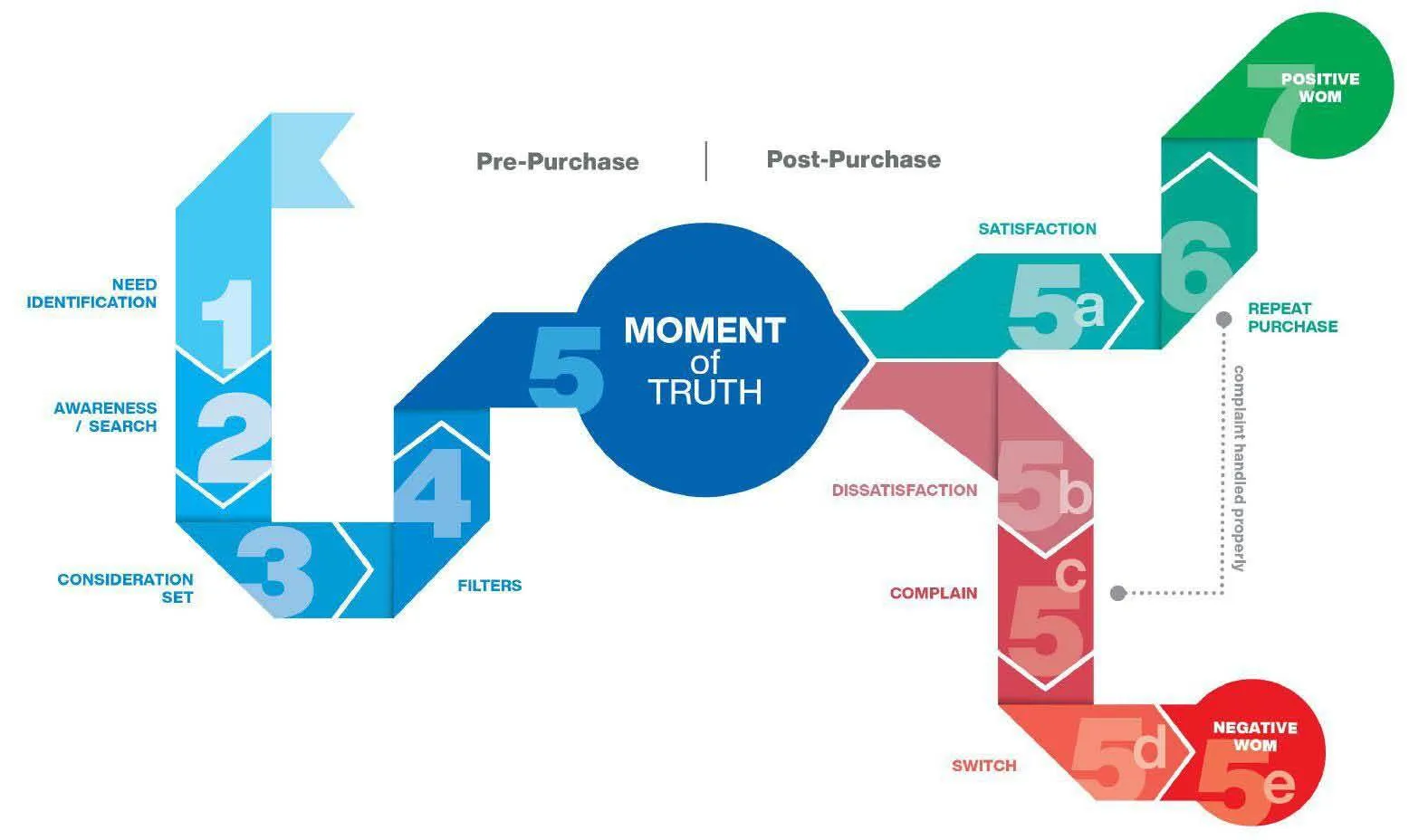
Initially this was to be the third and final part of a series that illustrates the process consumers go through at the time they begin to think about the purchase of a product or service to their post purchase behavior. However, given the importance of this topic, a fourth and final part will be added to this series. Part IV will appear in the next edition of this magazine.
To review, Figure 1 below illustrates the key components of this process. This model was developed in 1968 by economists, and over time other academic fields including sociology, psychology, and consumer behavior have created similar models for their disciplines. Our model reflects those designed by economists.
Part One of this series addressed sections 1–3 of the consumer purchase/buyer model. (Summer 2025.) Part Two addressed sections 4 and 5 of the consumer purchase model. (Fall 2025.) Part Three will address the Moment of Truth and ways to ensure a successful moment of trust leading to section 5a. The newly added Part IV will present what happens when the customer is dissatisfied.
Service providers can achieve great success at competing for customers if they conduct extensive research to understand consumers’ (1) pre-purchase behavior (e.g., wants, needs, desires), (2) barriers to purchase, and (3) post-purchase sentiments (e.g., satisfaction, willingness to buy the service again, and likelihood of spreading word of mouth). They can also achieve great customer satisfaction, and hence financial success, by ensuring they provide a great Moment of Truth (MOT). The definition of MOT and how to create a great MOT is discussed next.
READ THE FULL ARTICLE BY DR. STOWE SHOEMAKER THE WINTER 2025 EDITION OF GAMING & LEISURE MAGAZINE.